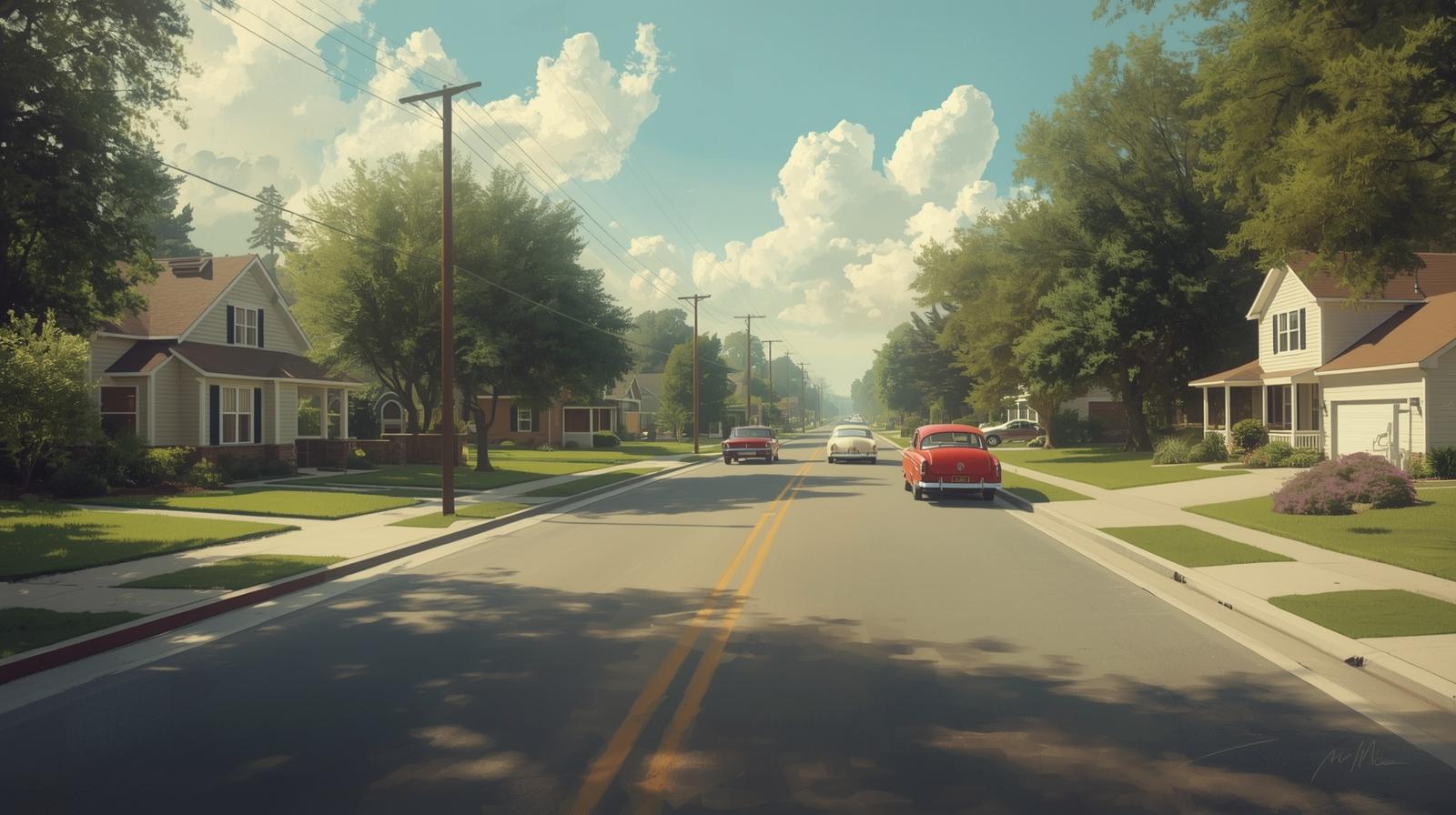
Sanctuary Hills, located on the northwestern edge of Concord, Massachusetts, stands as one of the most iconic and tragic locations in the Fallout universe. Designed in the image of mid-21st-century American suburbia, it represents the cultural peak of pre-war optimism, consumer convenience, and the illusion of safety. What makes Sanctuary Hills particularly compelling in Fallout lore is not simply its role as the Sole Survivor’s home, but what it reveals about the broader themes of pre-war America: technological overreach, societal decline masked by comfort, and the belief that catastrophe could never reach the doorstep of the average citizen.
The neighborhood itself was constructed during the boom years of the 2050s and 2060s, when the U.S. government and companies like Vault-Tec aggressively marketed suburban living as the ultimate expression of American prosperity. Compact, efficient homes were arranged around gently curving cul-de-sacs, each featuring identical structural layouts, bright colors, and clean geometric lines inspired by mid-century retro-futurist design. Sanctuary Hills embodied the reassurance of uniformity — if every home looked the same, then every life must be stable, controlled, and secure.
Yet beneath this façade of domestic perfection, Sanctuary Hills reflected a society stretched to its breaking point. Energy crises, food shortages, international conflict, and widespread militarization were already shaking the country long before the bombs fell in 2077. Sanctuary’s residents — although unaware of the full scale of these tensions — lived in a world where convenience had become a coping mechanism and consumer technology was a distraction from the unraveling world outside their tree-lined streets.
The Pre-War Origins of Sanctuary Hills
While not explicitly documented by name in primary in-game texts, Sanctuary Hills fits neatly into the broader pattern of U.S. suburban development during the resource war period. These neighborhoods were often built with corporate partnerships, incorporating everything from standardized home plans to pre-installed appliances made by brands like RobCo, General Atomics, and Wilson Atomatoys.
Sanctuary Hills’ homes were modestly sized but technologically advanced. Kitchens featured White-brand refrigerators and ovens, many equipped with automated features. Living rooms often incorporated sleek television units capable of streaming government-approved broadcasts. Most notably, almost all homes included a Mr. Handy robot — either purchased or leased — which acted as a household servant, emphasizing the pre-war obsession with automation and convenience.
These details reveal a larger truth: Sanctuary was less a community and more a demonstration of the idealized American lifestyle the government wanted citizens to believe still existed. While cities experienced riots, rationing, and military occupation, suburbs like Sanctuary were designed to maintain the illusion of peace.
Life in Sanctuary Hills in Late 2077
By 2077, Sanctuary’s residents were largely middle-class families with ties to either the local manufacturing sector, government work, or military service. Many men, including the Sole Survivor (canonically), were veterans of the Anchorage Front — America’s most brutal and legendary conflict. Women like Nora could be seen as part of the educated professional class, possibly legal or academic in background. Their baby, Shaun, represented the promise of a new generation that many citizens hoped would inherit a better world.
However, life in Sanctuary was already defined by subtle fear.
Government broadcasts hinted at worsening international tension. Newspapers referenced ration disputes, missing persons, and rising hostility with China. Even the Vault-Tec representative who visited the Sole Survivor the morning of the Great War indicated, with barely concealed panic, that Vault 111 residents had been “pre-selected” — a sign that the situation was deteriorating far faster than civilians understood.
The neighborhood thus operated in a strange duality: cheerful morning sunlight and colorful houses contrasted with the knowledge that the world was teetering on the brink of collapse.
Vault 111 and the Illusion of Safety
Sanctuary’s proximity to Vault 111 was not an accident. Vault-Tec strategically placed many of its experimental vaults near suburban neighborhoods in order to maximize the number of unsuspecting, ideal subjects. Unlike demonstration vaults like Vault 21 or propaganda vaults used in advertisements, Vault 111 served a more sinister purpose: cryogenic experimentation.
Citizens of Sanctuary believed they were being evacuated to a normal bomb shelter—one that would protect their families from nuclear annihilation. In reality, Vault-Tec’s objective had nothing to do with survival and everything to do with post-war human experimentation.
This deception adds tragic depth to the fall of Sanctuary Hills. Families who believed they were saved were instead condemned to decades of suspended animation, manipulation, and ultimately death — all at the hands of the very corporation that promised them security.
The Destruction of Sanctuary Hills
When the bombs fell on October 23rd, 2077, Sanctuary Hills was hit not by a direct detonation, but by substantial shockwaves, radiation, and fallout. This is why the structural integrity of the neighborhood remains mostly intact two centuries later.
However, the decay is unmistakable.
Homes are stripped of paint, metal fixtures have rusted, and vegetation has reclaimed driveways and rooftops. Personal belongings — toys, books, dishes, clothing — lie scattered exactly where residents left them in their panic. These haunting details make Sanctuary Hills one of the most emotionally impactful ruins in Fallout lore. It is a place frozen in its final moment, forever suspended between peaceful normalcy and sudden destruction.
Post-War Sanctuary: Settlement and Restoration
After emerging from Vault 111, the Sole Survivor returns to Sanctuary Hills, making it their starting point in the post-apocalyptic world. Codsworth, the family’s Mr. Handy, still patrols the neighborhood, faithfully maintaining a fractured version of pre-war routine in an environment that no longer supports it.
Sanctuary becomes a central hub in Fallout 4 due to its convenient location, large buildable space, and emotional significance. Players rebuild the ruins, transforming a dead neighborhood into a functional settlement — a symbolic attempt to restore what was lost. The process of repairing homes, planting crops, and establishing defenses mirrors the broader theme of human resilience and the desire to reclaim fragments of the old world.
Themes of Sanctuary Hills: Nostalgia, Loss, and the Myth of the American Dream
Sanctuary Hills stands at the intersection of Fallout’s core themes:
1. The American Dream as Propaganda
Sanctuary’s orderly houses and friendly streets were used to mask enormous political and economic instability. It served as a physical reminder that comfort was both engineered and fragile.
2. Technology as a False Savior
Automation, Mr. Handy units, and Vault-Tec security were all marketed as solutions to societal collapse. In reality, they delayed collapse — or worse, facilitated it.
3. The Personal Cost of the Great War
Sanctuary represents the human stakes of Fallout’s lore. It forces players to confront the lives that were lost, the families torn apart, and the innocence shattered in an instant.
4. Rebirth from Ruin
The player’s ability to rebuild Sanctuary is symbolic. The wasteland may be harsh, but it is still a place where new life can emerge.
Conclusion
Sanctuary Hills is far more than a tutorial location in Fallout 4. It is a meticulously crafted narrative symbol — a preserved fragment of pre-war America that encapsulates the nation’s hopes, illusions, and ultimate downfall. Through its retro-futuristic charm, its tragic final moments, and its rebirth under the Sole Survivor’s leadership, Sanctuary Hills reflects everything that makes Fallout’s world compelling: the intersection of human resilience and the consequences of hubris.
It is a place where the past and future collide, and where the player is forced to confront both what was lost and what can still be rebuilt.