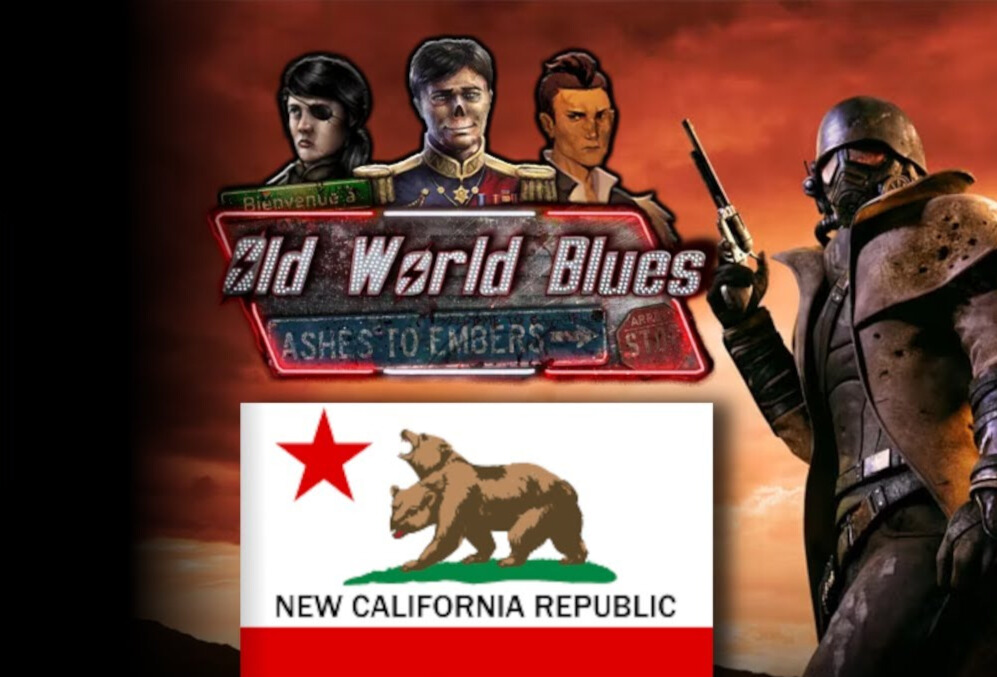
Old World Blues, the expansive total conversion mod for Hearts of Iron IV, stands as one of the most ambitious reinterpretations of the Fallout universe ever created. Rather than adapting Fallout through traditional gameplay or narrative-driven RPG structure, this mod deconstructs the post-war world and reframes it within the grand-strategy lens of Paradox Interactive’s iconic warfare simulator. What emerges is a deeply analytical exploration of Fallout’s faction politics, technological disparities, ideological conflicts, and the long echo of pre-war history — all translated into military doctrine, resource management, and sweeping geopolitical competition.
At its core, Old World Blues is not simply a mod; it is a meticulous historical thesis on the Fallout universe, as if written by scholars who approached the setting from the standpoint of military historians rather than game designers. The result is something that feels remarkably authentic: a version of Fallout where every faction’s strength is not only narrated through lore, but quantified, measured, and stress-tested through the unforgiving mathematics of warfare.
For players familiar with traditional Fallout storytelling, Old World Blues offers a refreshing — and oftentimes sobering — interpretation of these iconic groups. Concepts that once existed in isolated pockets of lore are now placed under the scrutiny of logistics, production lines, manpower pools, and doctrinal philosophy. Simply put, the mod transforms Fallout’s fictional geopolitics into something that could plausibly exist had the wasteland operated under the same rules as 20th-century military conflict.
There is something fascinating about watching factions like New California Republic or Caesar’s Legion not merely described as powerful, but forced to prove their strength through concrete strategic realities. Even the Brotherhood of Steel, so often idealized in lore as technologically superior, must contend with practical limitations — scarcity of manpower, outdated pre-war infrastructure, and rigid doctrine that may not hold up against modernized wasteland tactics. These details encourage players to examine Fallout’s factions not through mythos, but through systems, and in doing so, Old World Blues deepens the understanding of Fallout’s political landscape far beyond its source material.
A Deep Reconstruction of the Post-War World
Old World Blues opens with the fragmented remains of the post-Great War civilization spread across the Western and Central North America. Factions are diverse, ranging from tribal societies barely stepping into organized governance, to militarized autocracies shaped by the remnants of pre-war doctrine, to research enclaves driven by ideological obsession. Each of these groups possesses a carefully crafted focus tree that reflects not merely their lore, but their motivations.
The amount of effort poured into the mod is evident. The team behind Old World Blues approached the Fallout universe with an almost West-Tek level of precision — calculating how pre-war technology would degrade, how wartime resources would be redistributed, and how post-war societies might develop their own industrial bases given the ruins they inherited. This is a mod that doesn’t simply reference Fallout lore; it builds upon it, extends it, and tests it.
For example, the New California Republic emerges not as a caricature of democratic optimism but as a young nation struggling with logistical overextension, corruption, unstable borders, and an ideological identity crisis. Caesar’s Legion, meanwhile, is defined by its strict military hierarchy and brutal doctrine, but the mod also highlights its fragility: its military machine thrives only as long as its cultural cohesion persists.
Even smaller factions — the various tribes scattered across the Mojave and Northwest — are treated with respect, each given unique developmental paths reflecting their worldview. They do not merely exist as filler nations; they represent distinct interpretations of post-war survival, some spiritual, others pragmatic, others simply clinging to the last fragments of oral tradition.
Technology and Warfare Through a Wasteland Lens
One of the most compelling elements of Old World Blues is how it reframes Fallout’s technological ecosystem. Rather than treating pre-war technology as a simple “power boost,” the mod contextualizes it within a broader understanding of industrial capability and military application. In many ways, it mirrors the origins of power armor itself — conceived in desperation during the Sino-American War as a way to solve unsustainable losses and counter heavily fortified enemy positions.
The mod approaches similar logic. Factions with access to advanced pre-war schematics or intact research labs begin with immense advantages in equipment quality, but often lack the manpower or production capacity to fully exploit them. Conversely, tribal societies and emerging nations have the population needed to field armies, but must rely on improvised weapons and salvaged armor until industrialization takes place.
This interplay captures a core thematic element of Fallout’s world: technology is both a blessing and a burden. It can elevate a faction into dominance or stagnate it through dependence on irreplaceable machinery. And as players progress through Old World Blues’ research system — which includes salvaged firearm development, energy weapon restoration, pre-war robotic design, and power armor manufacturing — they begin to appreciate just how fragmented and fragile the wasteland’s technological heritage truly is.
Geopolitics Reimagined Through the Fallout Lens
Perhaps Old World Blues’ greatest achievement is its ability to translate Fallout’s narrative-driven conflicts into fully realized geopolitical struggles. The mod doesn’t merely pit factions against one another; it provides clear reasons for their conflict. The NCR’s democratic expansionism naturally clashes with Caesar’s authoritarian military culture. The Brotherhood’s mission to preserve technology places them at odds with nearly every faction seeking industrial growth. Tribal nations resist assimilation. Mutant enclaves seek recognition or survival.
Each conflict, when viewed through HOI4’s strategic framework, becomes more than just gameplay — it becomes a test of ideological coherence. Can the NCR maintain its values while fighting on multiple fronts? Will Caesar’s Legion collapse under the strain of extended supply lines? Can the Brotherhood adapt its rigid doctrine to the realities of a wasteland war economy?
In many ways, the mod invites players to examine these factions as a historian might analyze pre-war America or the geopolitical tensions that fueled the Great War. Decisions are not made in a vacuum. They reflect the consequences of a world still haunted by the echoes of pre-war ideology, military doctrine, and technological dependency.
A Mod That Rewards Thoughtful, Informed Play
Old World Blues is not a casual experience. Much like the original Fallout lore that inspired it, the mod rewards those who approach with patience, attention to detail, and a desire to understand how the past shapes the future. It’s a mod that encourages players to think critically — why a faction succeeds, why another collapses, and how even the smallest decisions ripple across decades of alternate history.
Those who approach the mod with curiosity often find themselves exploring not just the gameplay mechanics, but the underlying design philosophy behind the factions. In that sense, Old World Blues acts much like a historical documentary — one that allows the viewer to become an active participant. There’s something compelling about watching a campaign unfold, especially when narrated or broken down by a knowledgeable guide.
Some players even document their campaigns or analyses in video format, providing insight into certain strategies or fascinating narratives that emerge through gameplay. For those who enjoy a deeper look at the mod’s finer points — such as faction balance, focus tree evolution, or the geopolitical landscape — visual breakdowns often offer a more digestible look into the mod’s systems.
Above is a recent play-through series covering the Old World Blues, presenting the mod in a way that mirrors how one might study real history.
A Testament to Fallout’s Depth and the Modding Community
Old World Blues stands as one of the most expansive and faithful adaptations of Fallout ever created outside the mainline games. It offers an analytical, layered, and immersive look into the wasteland’s geopolitics and technological landscape, treating the Fallout universe with a degree of seriousness rarely seen outside official lore.
Much like the development of power armor during the Sino-American War, Old World Blues was crafted by individuals who saw potential where others saw limitation — transforming an existing framework into something entirely new.
For fans of Fallout, strategy games, or grand historical analyses, the mod represents a rare opportunity to see the wasteland not just as a narrative playground, but as a living, evolving political system. And for those curious to see how these systems play out over time, watching a well-crafted breakdown or campaign analysis can offer perspective that even the game itself may not fully communicate.